Bilgisayardan tüketici elektroniğine doğru kayan Apple, müzik dünyasında devrim yaratan iPod’dan sonra şimdi de iPhone adlı bir cep telefonu çıkardı.
İSTANBUL - Apple CEO’su Steve Jobs, iPhone’u San Francisco’da yapılan Macworld Konferansı’nda tanıttı. Apple iPhone’nun ekranı dokunmatik. Kullanıcı ikonlara dokunarak menüde müzik, internet, ses mesajı ve e-posta gönderebiliyor. Steve Jobs ayrıca Apple TV adlı bir video setini de basına gösterdi. Televizyona bağlanan 40 GB’lik Apple TV, bilgisayardan televizyona içerik aktarıyor. Jobs konuşmasında bilgisayar üreticisi olarak kurulan şirketin adının, yeni ürün profilini yansıtması için Apple Computer’dan sadece Apple’a çevrildiğini açıkladı.
Mac OS X işletim sistemi ile çalışacak, Microsoft Windows ile uyumlu olacak olan Apple iPhone’da 2 megapiksel dahili dijital kamera bulunuyor. Apple iPhone’un 4 GB’lik modelinin satış fiyatı yaklaşık 500 dolar, 8 GB’lik versiyonun ise 600 dolar civarında olacak ve Haziran ayında satışa çıkacak. Cep telefonunda Wi-Fi ve Bluetooth kablosuz standartlar? ve GPS bulunacak, ayrıca internetten Yahoo ve Google’ın servislerine bağlanacak.
İPOD’UN GÖLGESİNDE KALABİLİR
Bazı gözlemciler Microsoft’un da etkili olmaya çalıştığı cep telefonu pazarında, Apple’ın iPod başarısını yinelemesinin daha zor olacağını vurguluyor. Apple’ın müzik içeriği sağlayan iTunes sitesinden şimdiye dek 2 milyar şarkı, 50 milyon televizyon programı ve 1.3 milyon film satıldı. Apple, iPhone konusunda iPod’a göre biraz daha mütevazi bir öngörüye sahip. Şirket cep telefonundan 2008’e kadar 10 milyon adet satmayı düşünüyor. 2006’da 957 milyon adet cep telefon satıldığı düşünülürse Apple’ın hedefi pazarın yüzde 1’i.
Saturday, April 7, 2007

Apple iPhone: “Talk to you soon”
Apple sends email updates to those who signed up for iPhone information today.
Talk To You Soon.
Thanks for signing up. You’ll be the first to hear the latest about iPhone— coming this June. That gives you just enough time to think of ways to break the news to your current phone.
Apple and Cisco on iPhone: “We Can Work It Out”
Apple and Cisco are apparently back on iPhone trademark negotiations. Cisco has posted a joint statement regarding the iPhone trademark.
SAN FRANCISCO, Calif. January 31, 2007 - Apple and Cisco have agreed to extend the time for Apple to respond to the lawsuit to allow for discussions between the companies with the aim of reaching agreement on trademark rights and interoperability.
Apple and Cisco have been negotiating the use of iPhone trademark prior to MacWorld San Francisco 2007. Apple was reported to have abandoned negotiations the night before Steve Jobs Keynote. Cisco immediately filed a trademark infringement lawsuit against Apple for the use of iPhone trademark following the introductions of Apple iPhone by Steve Jobs.
http://newsroom.cisco.com/dlls/2007/corp_011007.html
According to many reports, apparently Apple is holding “iPhone” trademarks in most part of the world with the exceptions of The United States and Canada.
http://www.appleinsider.com/article.php?id=2145
http://10layers.com/2006/10/apple-filing-for-iphone-trademarks-worldwide/
http://news.com.com/2100-1036_3-6153865.html
According to some analyst Cisco might have lost their hold on “iPhone” trademark sometimes in 2006 for failing to use and defend the trademark.
http://blogs.zdnet.com/Burnette/?p=236
iPhone Teaser

I got this email from Apple today thanking me for signing up, 3 months ago, to get news about the launch, 2 months from now, of their $600 phone, that I wont be buying. Do I want an iPhone? Yes. Did this email remind me of that desire and further stoke those flames? Yes, again. Will I stamp out that desire? Hell, yeah! If you suffer from iPhone lust, one of the 7 deadly geek sins, all you have to do is remind yourself that after just one fall, splash, crash or slip your $600 work of art becomes just another expensive brick. For all its beautiful looks and interesting functionality I predict that these things are as brittle as a CEO’s ego. While I’m sure they be tons more successful then the Zune I’m still gonna wait till prices drop and and specs improve before adding to Jobs family trust.
iPhone o próximo Zune?
Depois das críticas do John Dvorak, dizendo que a apple deveria abandonar o iPhone e de ter verificado algumas notícias em que a Microsoft se prepara para subsidiar a venda do Zune como nos telemóveis, não pude deixar de estabelecer aqui uma pequena comparação:
O Zune é um falhanço porque a Microsoft quis meter-se num negócio que não entende e para o qual não estava preparada, alimentando o negócio do Zune na força da base que possuiu ao nível do sistema operativo. Ora o sistema operativo da Microsoft alavancou a venda de Zunes, mas quando o iPod continua a a dominar o mercado de players de mp3, não se pode dizer que a Microsoft tenha um vencedor.
De momento o iPhone está completamente “na moda”, mas não posso deixar de pensar que a apple está a fazer exactamente o mesmo que a Microsoft, entrando num mercado que não conhece e alavancando o iPhone num sistema operativo (OSX Light!)
Será que o iPhone se vai transformar para a apple no mesmo que a Zune para a Microsoft? Eu acredito que sim…
Our iPhone Review
The Apple iPhone is a cross between an iPod and an advanced mobile phone and will be launched in the US sometime during June 2007 and in the UK around October 2007.
While it is clearly the most anticipated mobile phone ever released it is also full of innovative features and looks sleeker and more stylish than most other phones as well.
The casing is small at 115 x 61 x 11.6 mm and weighs just 135 grams and is available in sleek black or a pearly white colour. The main feature is the huge touch sensitive widescreen which acts as the main interface with the phone. At 3.5 inches and 320×480 pixels the iPhone has one of the biggest screens ever on a phone. Navigation is easy thanks to the touch screen and intuitive Mac OS X icon driven menu system
Like the iPod Apple have made the iPhone available in 4GB and 8GB versions. Battery life is good so you can play music uninterrupted for 16 hours. Talk time is apparently 5 hours.
As you might expect the iPhone has a photo address book with easy controls. Simply click on the persons picture to call them or send a text. Other nice functions are a favourite calls list automatically generated from the people you call most and a conference call feature.
Emails and text messages are very easy thanks to the touch sensitive screen which converts into a full QWERTY keyboard with predictive text and auto correct for any typing errors. Supported email applications include POP3, Microsoft Exchange, AOL, Gmail and Apple Mac Mail. Unlike a lot of phones the iPhone supports photos and attachments in emails making it more like a PC than a cell phone.
Our favourite feature is the visual voicemail application which shows new answer phone messages on the screen with options to listen, save or delete the message or call the person who left it. The date, time and duration of the message are also displayed on the screen.
The music player works in much the same way as an iPod and allows the user to scroll through tracks and upload or download to a PC. Album covers can also be stored and used on the iPhone which has an innovative search facility so you can scroll through images like you would flick through a filing cabinet.
Although the camera isn’t as good as some high end phones like the Sony Ericsson K800i it is capable of some very high quality images and offers editing software so you can touch up photos and videos without having to load the pictures onto a PC.
Internet access is amazing thanks to the large screen and makes the iPhone the best internet phone we have ever tested. Google is built in and you can use Google Maps to get directions based on your location. The internet is fast due to the EDGE connection and Apple have also given the iPhone Wi Fi so you can sync with other devices with ease.
Finally the coolest feature is the automatically changing screen that detects whether the phone is upright or in landscape mode and rotates accordingly.
iPhone Mobile Phone
| The amazing Apple iPhone is a combination of the iconic iPod, a fully featured high end mobile phone and a tablet PC. With advanced web browsing, email, maps, and a touch screen the iPhone has redefined how mobile phones should perform. | ||||
 |
| |||

eBay Watch: Apple iPhone 4GB Selling for $1,425

That’s right, an Apple iPhone 4GB preorder is selling for a whopping $1,425 on eBay. Would you trust this seller? Auction page.
The winner of this auction will receive, One Apple iPhone In Brand New - Never Opened - Condition. I am a direct supplier that will receive many of these units the night before launch. The physical iPhone will ship on the release date that is soon to be announced by Apple. Currently, the only supported Carrier is CINGULAR
Cisco Unveils the iPhone?

That’s right, Cisco trademarked “iPhone” in the early 90’s and have just announced that they will be releasing “iPhone” branded VoIP systems. They include “the $180 iPhone Dual-Mode Internet Telephony Kit for Skype CIT400 (pictured), the $200 iPhone Wireless-G Phone for Skype WIP320, [and] a SIP VoIP phone.”
Why wait until now to launch the iPhone name? We can’t say for sure, but we imagine Cisco was probably trying to work behind the scenes to sell the rights to the name to Apple, but things didn’t pan out — but since “iPhone” is already a fairly ubiquitous brand without even being launched, hey, why not run with it?
Verizon Misses Out On iPhone Deal

Yes, Apple had originally pitched the iPhone to Verizon Wireless, as far back as two years ago, but unfortunately, the two couldn’t come to an agreement.
…Apple’s demands were steep. They also give us an idea of what exactly is behind the Apple / Cingular agreement: Apple wanted a percentage of monthly service fees, control over distribution that would limit iPhone sales to Apple and Verizon stores, and even some control over service and support for iPhone customers. “They would have been stepping in between us and our customers to the point where we would have almost had to take a back seat … on hardware and service support,” say Gerace
Apple iPhone Concept

You’ve seen the Motorola ROKR iTunes Phone now check out this Apple iPhone concept. Will Apple really come out with its own phone? From the concept, it looks to feature a brushed metal case and a clamshell type design. Personally, I think Apple should just stick with computers and MP3 players. Click “more” for another image.

The Apple iPhone
Apple's new iPhone looks like a thing of beauty. Widescreen touch interface, no buttons, runs OS X, useful widgets, integrated email, Google Maps, Google/Yahoo search, visual voicemail (see who voicemail is from before you call), SMS, Wifi, etc. etc. Oh, and it plays music.
A lot of people are wondering just how big this thing is. Using the technical specs from apple.com, I grabbed some cardboard, scissors, and glue and made a scale model of the iPhone. Here it is:
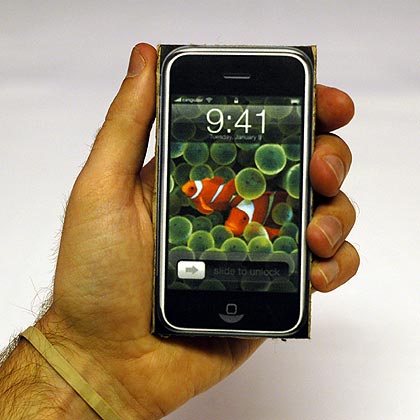
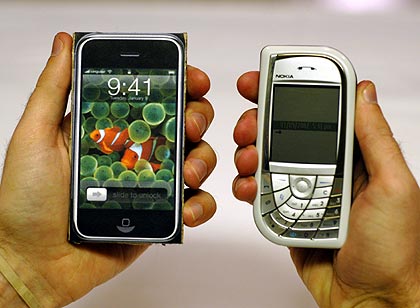
My hands aren't that big (I can barely palm a basketball on a good day), but it still seems to fit pretty well. How does it stack up against similar devices?
Here's the iPhone vs. my current mobile phone, the Nokia 7610:
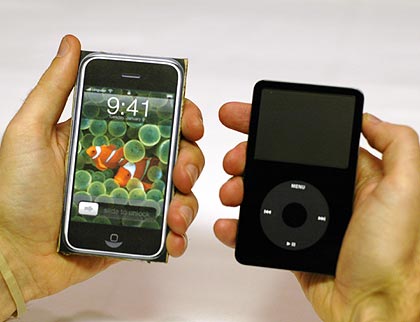
iPhone vs. a 5G iPod:
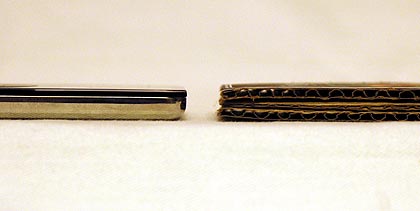
Thickness of the cardboard iPhone vs. the 5G iPod:
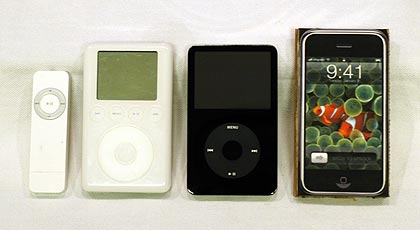
1G iPod shuffle, 3G iPod, 5G iPod and the iPhone:
iPhone vs. a TiVo remote and a Wii remote:
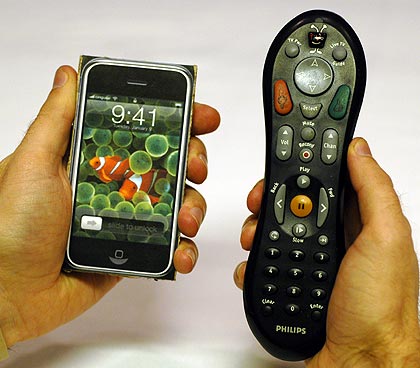
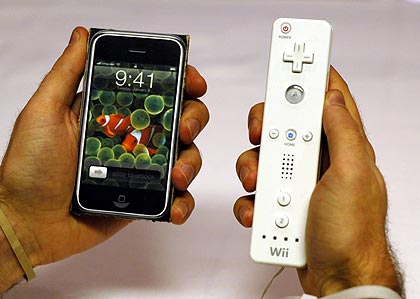
That's all the gadgets I could find on a couple of hours notice.
I also dug up something I wrote a couple of years ago in the gigantic text file I keep on my Powerbook of ideas for kottke.org posts. 99% of the stuff in that file is completely dunderheaded, but I have to say I hit close to the mark on this one:
true convergence of phone + mp3 player will happen when someone solves this user experience puzzle: physically not enough room for two optimized interfaces (one for calls, one for music) on same small device. possible solution: no buttons, replace with touch screen that covers the whole front with one-touch switching between modes...
Once we're able to get our hands on it and use the interface, the iPhone could turn out to be a disappointment, but they're heading in the right direction at least. More thoughts soon.
Jobs talks up Apple cell phone
Apple Computer chief executive Steve Jobs has been boasting about his company's much-rumored iPod cell phone amongst inner circles, AppleInsider has been told.
The remarks are uncharacteristic of Jobs, who is often regarded for his obsession with secrecy -- especially when it comes to unannounced products from his own company. But it's been said that Jobs' own excitement over the device has produced a number of zealous ramblings amongst personal acquaintances dating back to this spring.
One person familiar with the ongoings believes the Apple cofounder has commissioned the release of cell phone prototypes to at least two potential OEM manufacturing partners in recent months. Current designs are said to conform to Apple's integrated model and leverage its tightly-knit digital media franchises, that person added.
Speaking on conditions of anonymity, a second informant has told AppleInsider of an incremental buzz surrounding the phone, which has heightened in recent weeks. The informant, who flourishes a nearly unblemished track record in predicting Apple's future music directions, has said the device is slated to turn up earlier than some people may be expecting, in the form of a "big bang" introduction that will catch even some insiders off-guard.
By now, the notion of an Apple-branded iPod cell phone has grown from rumor to expectation, fueled in part by analysts on Wall Street who have become increasingly vocal in their convictions that Apple is developing such a device.
Upon exiting a meeting with the company's leadership earlier this year, Bear Stearns analyst Andy Neff said it was his belief an iPod phone was "in the works." Similarly, Shaw Wu, an analyst with American Technology Research, recently stated his "firm" belief that Apple has been working on cell phone technology.
Wu said the Cupertino, Calif.-based company is likely to adopt an MVNO (mobile virtual network operator) strategy, where it will not own a licensed frequency spectrum, but instead resell wireless services from larger providers under its own name. Such an approach would allow Apple to maintain tight control over the phone's user experience, he said.
However, Wu is like a handful of analysts that are doubtful Apple will be able to roll-out its mobile strategy until mid-2007 at the earliest. Instead, the analyst believes the company is still working out its go-to-market strategy and may need the additional time.
For Apple, a long-running concern about offering an iPod cell phone is the risk that it may cannibalize the low-end flash player market, which includes its 1GB and smaller capacity iPod digital music players.
"The company has said it is possible that a music-enabled phone could cannibalize the demand for a lower priced iPods," PiperJaffray analyst Gene Munster recently told his clients. He equates the conflict to the inclusion of digital cameras in cell phones, which did not impact demand for higher end cameras, but weighed on the lower-end market.
"While we continue to believe there is a high chance that Apple will launch an iPhone in the next 12 months, the company says that the right path for Apple is to continue to pursue devices with one primary feature and not focus on multiple ********s in one device," Munster said.
Still, Apple has been known to make diversionary comments in an effort to safeguard its future product plans. During a conference call with media and analysts in October 2004, a member of the company's executive team stated that Apple had no plans to enter the sub-$800 PC market and would instead focus its efforts on its booming music business and related products. Less than three months later, Apple introduced its first sub-$500 computer: the Mac mini.
For these and other reasons, the mainstream media has been unwilling to relent in its probes into the possibility of an iPod cell phone. At times, even Jobs appears to have been caught slightly off guard by the barrage. At the launch of the Apple Store Fifth Avenue in Manhattan this May, a CNBC reporter abruptly asked the Apple chief when consumers would be able to buy an Apple iPhone.
"You know, we never talk about unannounced products," said Jobs, "...but if we ever do announce something like that I'd love to talk to you about it then."
Jobs may have been speaking literally, say insiders, who note that he is unlikely to proceed with plans to bring the device to market unless all the pieces fall smoothly into play at the right time. "It must ******** as seamlessly as it looks," said a source. "That's the only way he will have it."
The mercurial CEO has watched new product initiatives span well into their respective development cycles before deciding to pull the plug for one reason or another. A known perfectionist, Jobs has also gone on record in saying that he is just as proud of the products Apple has shipped over the year's as he is with the company's deciscion not to ship others.
But it's looking increasingly unlikely that Apple's mobile initiative will fall by way of the ax. Perhaps the most telling piece of evidence to this end came during the company's quarterly conference call last month. During the call, an analyst pressed members of Apple's leadership for their thoughts on the tremendous growth Sony has realized with its relatively new Walkman phone. Apple's chief financial officer Peter Oppenheimer fielded the question by saying, "We don’t think [...] phones that are available today make the best music players. We think the iPod is, but over time that’s likely to change." He then added, "And we are not sitting around doing nothing."
The remarks are uncharacteristic of Jobs, who is often regarded for his obsession with secrecy -- especially when it comes to unannounced products from his own company. But it's been said that Jobs' own excitement over the device has produced a number of zealous ramblings amongst personal acquaintances dating back to this spring.
One person familiar with the ongoings believes the Apple cofounder has commissioned the release of cell phone prototypes to at least two potential OEM manufacturing partners in recent months. Current designs are said to conform to Apple's integrated model and leverage its tightly-knit digital media franchises, that person added.
Speaking on conditions of anonymity, a second informant has told AppleInsider of an incremental buzz surrounding the phone, which has heightened in recent weeks. The informant, who flourishes a nearly unblemished track record in predicting Apple's future music directions, has said the device is slated to turn up earlier than some people may be expecting, in the form of a "big bang" introduction that will catch even some insiders off-guard.
By now, the notion of an Apple-branded iPod cell phone has grown from rumor to expectation, fueled in part by analysts on Wall Street who have become increasingly vocal in their convictions that Apple is developing such a device.
Upon exiting a meeting with the company's leadership earlier this year, Bear Stearns analyst Andy Neff said it was his belief an iPod phone was "in the works." Similarly, Shaw Wu, an analyst with American Technology Research, recently stated his "firm" belief that Apple has been working on cell phone technology.
Wu said the Cupertino, Calif.-based company is likely to adopt an MVNO (mobile virtual network operator) strategy, where it will not own a licensed frequency spectrum, but instead resell wireless services from larger providers under its own name. Such an approach would allow Apple to maintain tight control over the phone's user experience, he said.
However, Wu is like a handful of analysts that are doubtful Apple will be able to roll-out its mobile strategy until mid-2007 at the earliest. Instead, the analyst believes the company is still working out its go-to-market strategy and may need the additional time.
For Apple, a long-running concern about offering an iPod cell phone is the risk that it may cannibalize the low-end flash player market, which includes its 1GB and smaller capacity iPod digital music players.
"The company has said it is possible that a music-enabled phone could cannibalize the demand for a lower priced iPods," PiperJaffray analyst Gene Munster recently told his clients. He equates the conflict to the inclusion of digital cameras in cell phones, which did not impact demand for higher end cameras, but weighed on the lower-end market.
"While we continue to believe there is a high chance that Apple will launch an iPhone in the next 12 months, the company says that the right path for Apple is to continue to pursue devices with one primary feature and not focus on multiple ********s in one device," Munster said.
Still, Apple has been known to make diversionary comments in an effort to safeguard its future product plans. During a conference call with media and analysts in October 2004, a member of the company's executive team stated that Apple had no plans to enter the sub-$800 PC market and would instead focus its efforts on its booming music business and related products. Less than three months later, Apple introduced its first sub-$500 computer: the Mac mini.
For these and other reasons, the mainstream media has been unwilling to relent in its probes into the possibility of an iPod cell phone. At times, even Jobs appears to have been caught slightly off guard by the barrage. At the launch of the Apple Store Fifth Avenue in Manhattan this May, a CNBC reporter abruptly asked the Apple chief when consumers would be able to buy an Apple iPhone.
"You know, we never talk about unannounced products," said Jobs, "...but if we ever do announce something like that I'd love to talk to you about it then."
Jobs may have been speaking literally, say insiders, who note that he is unlikely to proceed with plans to bring the device to market unless all the pieces fall smoothly into play at the right time. "It must ******** as seamlessly as it looks," said a source. "That's the only way he will have it."
The mercurial CEO has watched new product initiatives span well into their respective development cycles before deciding to pull the plug for one reason or another. A known perfectionist, Jobs has also gone on record in saying that he is just as proud of the products Apple has shipped over the year's as he is with the company's deciscion not to ship others.
But it's looking increasingly unlikely that Apple's mobile initiative will fall by way of the ax. Perhaps the most telling piece of evidence to this end came during the company's quarterly conference call last month. During the call, an analyst pressed members of Apple's leadership for their thoughts on the tremendous growth Sony has realized with its relatively new Walkman phone. Apple's chief financial officer Peter Oppenheimer fielded the question by saying, "We don’t think [...] phones that are available today make the best music players. We think the iPod is, but over time that’s likely to change." He then added, "And we are not sitting around doing nothing."
Apple unveils iPhone
After more than two years in the making, Apple CEO Steve Jobs Tuesday announced the company’s intention to enter the mobile handset market, unveiling the new Apple iPhone. The iPhone brings together several features of the iPod, digital camera, smart phones and even portable computing to one device, with a widescreen display and an innovative input method.
“Every once in a while a revolutionary product comes along that changes everything,” Jobs said.
Featuring a new input technology called “Multi-Touch” the iPhone features only a single physical button, called “home.” You control the phone by sliding a finger across its touch-sensitive 3.5-inch display, which has a resolution of 320-by-480 pixels at 160 pixels-per-inch display.
The iPhone, which runs Mac OS X, has full iTunes integration and can seamlessly sync data with a Mac, PC, or Internet service, including music and videos from iTunes, contacts, calendars, photos, notes, bookmarks and e-mail accounts.
The 0.46-inch (11.6-millimeter) thick device weighs 4.8 ounces (135 grams) and sports a 2-megapixel camera, volume control, ring-silent switch, 3.5-millimeter headset/audio jack, SIM tray, “sleep-wake” switch, speaker, microphone, and a 30-pin iPod dock connector. The quad-band GSM (850MHz, 900MHz, 1800MHz, and 1900MHz) + EDGE phone also has 802.11b/g Wi-Fi and Bluetooth 2.0 capabilities. Jobs noted 3G capabilities will come in the future.
Three smart sensors also help control the iPhone’s behavior. A proximity sensor shuts down the display and touchscreen when the phone is held to the ear. An ambient light sensor automatically adjusts screen brightness to save power. Meanwhile, an accelerometer lets the phone know whether to display in portrait or landscape mode.
 |
Despite the phone’s revolutionary features, Jobs claimed that the phone’s strongest feature was its redefinition of how calls are made.
“We want to reinvent the phone,” Jobs said. “What’s the killer app? The killer app is making calls. It’s amazing how hard it is to make calls on phones. We want you to use contacts like never before.”
A Visual Voice-mail feature allows users to skip directly to voice mails they want to hear. An easy-to-use conference call feature lets users connect two calls with one touch of the screen. Text messaging on the iPhone is similar to iChat, with user dialogue encased in bubbles and with familiar iChat sounds, and a touch keyboard appears below for entering text.
The iPhone uses its Wi-Fi and EDGE capabilities to automatically connect to the Internet. Internet connectivity includes HTML-capable e-mail that works with any IMAP or POP3 e-mail service. Jobs also announced that Yahoo will offer free push e-mail—similar to the e-mail system on a Blackberry—to all iPhone customers.
Apple also included its Safari web browser, and the phone can use its Internet capabilities to view standard Web pages, rather than WAP versions of pages. Integrated Google Maps functionality lets users look up locations, search for local businesses, and view satellite imagery. The iPhone also supports Dashboard widgets, and Apple announced it will include weather and stock widgets.
The iPhone’s photo management features are equally interesting. Its software enables users to use a “pinching” motion to zoom in and out of pictures, and to orient pictures in standard or landscape mode. When playing music, the iPhone can automatically adjust levels up or down as calls come in.
The iPhone will come in two versions: a 4GB, $499 model and an 8GB, $599 model. Both will require a two-year contract with Cingular, the exclusive U.S. carrier. Both models will be available beginning in June from Apple Stores and from Cingular.
Jobs said Apple plans to bring the iPhone to Europe in the fourth calendar quarter of 2007, and to Asia in 2008. Jobs also mentioned two accessories for the iPhone: stereo headphones with integrated microphone, and a Bluetooth headset that pairs automatically with the iPhone and goes to sleep to preserve battery life.iPhone Info [Deutsch]
Apple iPhone vereint drei Produkte - ein revolutionäres Mobiltelefon, einen iPod mit berührungssensitivem Breitbild-Display und ein bahnbrechendes Internet-Kommunikationsgerät mit E-Mail, Webbrowser, Kartendienst und Suche auf Desktop-Niveau - in einem kleinen und leichten Handheld-Gerät.
Mit iPhone wird eine völlig neue Benutzeroberfläche eingeführt, die auf einem großen Multitouch-Display und neuer Software basiert, über die sich alle Funktionen mit den Fingern bedienen lassen. Apple iPhone leitet eine neue Ära ein, mit bis daher noch nie gesehener leistungsfähiger Software bei mobilen Geräten.
Ungleich der meisten Smartphones wird das iPhone nicht über eine eingebaute Tastatur oder einen Ziffernblock verfügen; die Eingabe erfolgt über eine Kombination von Technologien, zu denen ein Sensorbildschirm mit Software gesteuerter virtueller Tastatur und Tasten gehört. Apple hat angedeutet, dass verschiedene der Mac OS X Betriebssysteme auf dem iPhone verwendet werden. Der Unterschied zwischen dem Betriebssystem (OS X) das auf Macs verwendet wird und dem iPhone wird offiziell nicht erklärt. Anwendungen Dritter sind bis zum jetzigen Zeitpunkt auf ein „kontrolliertes Umfeld“ limitiert.
Die Veröffentlichung des iPhone ist für Juni 2007 geplant, abhängig von der Genehmigung der Federal Communications Commission. Das iPhone wird voraussichtlich im Apple Store und über Cingular erhältlich sein. Der geplante Einführungspreis des iPhones liegt bei 499 US-Dollar für das 4 GB Modell und 599 US-Dollar für das 8 GB Modell. iPhone unterstützt Quad-Band GSM. Jobs erwähnte jedoch auch, dass Apple plant, in der Zukunft 3G-Telefone herzustellen. Apple hat mehr als 200 Patente angemeldet, die mit der Technologie des iPhone zusammenhängen.
Eigenschaften
Der 3.5-inch Widescreen Display (320×480 px bei 160 ppi) Sensorbildschirm wurde speziell für die Fingerbedienung entwickelt (mehrere Finger können zur gleichen Zeit benutzt werden), ein Taststift wird nicht benötigt.![[Keine Beschreibung eingegeben]](http://www.iphoneinfo.de/files/iphoneinfo.jpg)
Die Bedienung des Fotoalbums ist ein Beispiel der Multi-Touch Abtastung, wie sie kürzlich von Jefferson Y. Han demonstriert worden ist. Die Kontrolltasten für das Telefon können vom Benutzer für jede Kontrolle reprogrammiert werden, die er sich wünscht. Um den Sensorbildschirm des Telefons zu entsperren, muss der Benutzer seinen Finger auf der Unterkante des Bildschirms von links nach rechts führen.
Das Gerät nutzt eine eingebaute virtuelle Tastatur, die durch den Sensorbildschirm möglich gemacht wurde. Es verfügt über eine automatische Rechtschreibprüfung. Die virtuelle Tastatur erscheint, wenn sie benötigt wird, und verschwindet, wenn der Benutzer mit dem Tippen fertig ist.
Anstatt eines Windowed Desktop Metaphor nutzt das iPhone ein Zooming User Interface. Die Benutzeroberfläche ist erwähnenswert, weil es das erste kommerzielle Gerät ist, das einen ZUI mit multi-touch Interaktionstechnologien kombiniert. Gemeinsam mit den eingebauten Sensoren ermöglichen diese komplexe Interaktionen und einfach Kontrolle von zahlreichen unabhängigen Anwendungen in einem kleinen Gerät.
Das Gerät verfügt außerdem über drei Sensoren: einen Näherungssensor, der den Sensorbildschirm ausschaltet, wenn das iPhone nahe ans Ohr gebracht wird (um Batterieleistung zu sparen und um durch ungewollten Kontakt mit Gesicht und Ohren des Benutzers ausgelöste Telefoneigenschaften zu vermeiden), einen Umgebungslichtfühler, der die Bildschirmhelligkeit anpasst und so Energie spart, und einen Schwingungssensor, der die Ausrichtung des Telefons wahrnimmt und den Bildschirm entsprechend anpasst.
Telefon
Das iPhone erlaubt 3-Wege Konferenzen, Anruf "Halten", Anrufe "Mischen", Anrufer "ID" und die Integration mit iPhone Funktionen. Ein gerade spielendes Lied wird ausgeblendet, wenn der Benutzer einen Anruf erhält. Wenn der Anruf beendet ist, wird das Lied ohne Unterbrechung eingeblendet.
Das iPhone wird eine visuelle Mailboxfunktion in Verbindung mit Cingular beinhalten, die dem Benutzer erlaubt, die aktuellen Mailboxnachrichten auf dem Bildschirm zu sehen, ohne die Mailbox anrufen zu müssen. Mailboxnachrichten werden durch Anwahl vom Benutzer abgespielt.
SMS werden in einem Mailboxformat, ähnlich dem von E-Mail, chronologisch dargestellt. Dieses ordnet automatisch alle SMS von Empfängern. SMS sind in Sprechblasen unter dem Namen eines jeden Empfängers dargestellt (ähnlich iChat).
Kamera
Das iPhone besitzt eine 2 Megapixel-Kamera und eine Fotoverwaltungssoftware, die dem Benutzer das Hochladen, Ansehen und Verschicken von Fotos per E-Mail möglich macht. Es ist möglich, in Fotos hinein- und aus ihnen heraus zu zoomen, in dem sie mit zwei Fingern auseinander bzw. zusammen „gedrückt“ werden.
iPod
Die Gestaltung der Musikbibliothek unterscheidet sich von bisherigen iPods, da die Teilbereiche deutlicher nach Alphabet geordnet sind und diese über eine größere Vorderseite verfügt. Das Cover Flow, wie bei iTunes, zeigt die Albumcover in einer durchblätterbaren Fotobibliothek an. Das Durchblättern funktioniert über ein Wischen des Fingers über den Bildschirm.
Wie die fünfte Generation der iPods, die in 2005 eingeführt worden ist, kann auch das iPhone Videos abspielen, wodurch der Benutzer TV-Sendungen und Filme ansehen kann. Um zwischen Breitbild- und Vollbildschirmmodi zu wechseln, reicht ein Tippen mit zwei Fingern aus.
Internet Kommunikator
Das iPhone hat einen eingebauten WiFi, mit Hilfe dessen es (durch ein drahtloses Netzwerk) über den Safaribrowser Zugang zum Internet hat. Das iPhone wird außerdem fähig sein, sich über das EDGE Netzwerk von Cingular ins Internet einzuwählen. Der Webbrowser zeigt im Gegenteil zu den vereinfachten Webseiten, die auf anderen Telefonen angezeigt werden, ganze Webseiten an. Webseiten können im Portrait- oder im Landschaftsmodus angesehen werden und unterstützen automatisches Zoomen durch „zusammen drücken“ oder Doppeltippen von Bildern oder Texten. Direktes Herunterladen von Dateien aus dem iTunes Store wird nicht unterstützt. Das iPhone verfügt über ein eingebautes Bluetooth und arbeitet mit kabellosen Hörmuscheln, die die Bluetooth 2.0 Technologie verwenden.
Das iPhone verfügt über einen vollwertigen HTML-E-Mail-Client, der die Mails von den meisten POP3- oder IMAP-Maildiensten im Hintergrund abruft und neben Text auch Fotos und Grafiken anzeigt. iPhone ist Multitasking-fähig, sodass sich eine Webseite lesen lässt während gleichzeitig die E-Mails im Hintergrund abgerufen werden.
Das iPhone ist auch mit einem HTML-E-Mailprogramm ausgestattet, dass es dem Benutzer ermöglicht, Fotos in E-Mailnachrichten einzubetten. Yahoo! Wird einen kostenlosen Push-IMAP E-Mailservice anbieten, ähnlich dem des BlackBerry; IMAP und POP3 Mailstandards werden ebenfalls unterstützt, inklusive Microsoft Exchange.
Widgets, ähnlich denen des Mac OS X v10.4's Dashboards, sind im iPhone inbegriffen. Die in der Macworld 2007 angegebenen Beispiele waren die Aktien- und Wetter-Widgets.
Eine Vereinbarung zwischen Apple und Google macht den Zugang zu einer modifizierten Version von Google Maps möglich – in Karten-, lokaler Liste- oder Satellitenformat, für das iPhone optimiert. Während der Einführung des Produkts führte Jobs diese Funktion vor, indem er nach nahen Cafés suchte und dann eins von ihnen durch ein einziges Fingertippen anrief.
Weiteres
Wie auch andere iPods, aber ungleich der Mehrzahl der Mobiltelefone, verfügt das iPhone über eine eingebaute Batterie, die nicht vom Benutzer ausgewechselt werden kann. Die Batterie macht 5 Stunden Videowiedergabe, Webbrowsing oder Sprechzeit möglich. Die Batterie reicht für 16 Stunden Musikwiedergabe aus.
Es wird neue Kopfhörer geben, die denen der gegenwärtigen iPods ähnlich sind, jedoch ein Mikrofon beinhalten. Anrufe können durch Drücken des Mikrofons beantwortet und beendet werden. Drahtlose Hörmuscheln, die Bluetooth-Technologie zur Kommunikation mit dem iPhone benutzen, werden separat verkauft. Der Lautsprecher wird sowohl zum Freisprechen als auch zur Medienwiedergabe verwendet.
Das iPhone kann mit dem Apple’s iCal (für Kalender und Notizen), Adressbuch (für Telefonnummern) und iTunes synchronisiert werden. Windows-Benutzer können nur die iTunes-Synchronisation verwenden. Das E-Mailprogramm Outlook für Windows kann nicht mit dem iPhone synchronisiert werden.
Preise & Verfügbarkeit
Jobs kündigte an, dass das iPhone zuerst im Juni 2007 in den USA erhältlich sein wird, im 4. Quartal 2007 in Europa und in Asien 2008. Die Verfügbarkeit in Kanada wurde von Apple offiziell noch nicht angekündigt. Die anfängliche Veröffentlichung in den USA wird in zwei Konfigurationen mit zwei unterschiedlichen Preisen angeboten werden, die auf einem 2-Jahrestelefonvertrag basieren: als 4 GB-Modell für 499 US-Dollar und als 8 GB-Modell für 599 US-Dollar.
Apple kündigte ebenfalls an, dass sein Ziel sei, 1 % des globalen Mobiltelefonmarkts (mit einer Stückzahl von ca. 1 Billion) zu erobern. Dies würde annähernd 10 Millionen verkaufte Geräte in 2008 bedeuten, dem ersten vollen Kalenderjahr, in dem das iPhone verfügbar ist. Zum Vergleich: Jobs gab bekannt, dass der Apple iPod über einen Anteil von 62 % des U.S. Markts für MP3-Player verfügt.
In verschwiegenen Verhandlungen, die im Februar 2005 begonnen hatten, wurde ein Vertrag ausgehandelt, der festlegt, dass Cingular Wireless das iPhone in den USA bis zum Jahr 2009 exklusiv vertreiben wird. Das iPhone kann nur in Kombination mit einem 2-Jahresvertrag mit Cingular erworben werden.
Mit iPhone wird eine völlig neue Benutzeroberfläche eingeführt, die auf einem großen Multitouch-Display und neuer Software basiert, über die sich alle Funktionen mit den Fingern bedienen lassen. Apple iPhone leitet eine neue Ära ein, mit bis daher noch nie gesehener leistungsfähiger Software bei mobilen Geräten.
Ungleich der meisten Smartphones wird das iPhone nicht über eine eingebaute Tastatur oder einen Ziffernblock verfügen; die Eingabe erfolgt über eine Kombination von Technologien, zu denen ein Sensorbildschirm mit Software gesteuerter virtueller Tastatur und Tasten gehört. Apple hat angedeutet, dass verschiedene der Mac OS X Betriebssysteme auf dem iPhone verwendet werden. Der Unterschied zwischen dem Betriebssystem (OS X) das auf Macs verwendet wird und dem iPhone wird offiziell nicht erklärt. Anwendungen Dritter sind bis zum jetzigen Zeitpunkt auf ein „kontrolliertes Umfeld“ limitiert.
Die Veröffentlichung des iPhone ist für Juni 2007 geplant, abhängig von der Genehmigung der Federal Communications Commission. Das iPhone wird voraussichtlich im Apple Store und über Cingular erhältlich sein. Der geplante Einführungspreis des iPhones liegt bei 499 US-Dollar für das 4 GB Modell und 599 US-Dollar für das 8 GB Modell. iPhone unterstützt Quad-Band GSM. Jobs erwähnte jedoch auch, dass Apple plant, in der Zukunft 3G-Telefone herzustellen. Apple hat mehr als 200 Patente angemeldet, die mit der Technologie des iPhone zusammenhängen.
Eigenschaften
Der 3.5-inch Widescreen Display (320×480 px bei 160 ppi) Sensorbildschirm wurde speziell für die Fingerbedienung entwickelt (mehrere Finger können zur gleichen Zeit benutzt werden), ein Taststift wird nicht benötigt.
Die Bedienung des Fotoalbums ist ein Beispiel der Multi-Touch Abtastung, wie sie kürzlich von Jefferson Y. Han demonstriert worden ist. Die Kontrolltasten für das Telefon können vom Benutzer für jede Kontrolle reprogrammiert werden, die er sich wünscht. Um den Sensorbildschirm des Telefons zu entsperren, muss der Benutzer seinen Finger auf der Unterkante des Bildschirms von links nach rechts führen.
Das Gerät nutzt eine eingebaute virtuelle Tastatur, die durch den Sensorbildschirm möglich gemacht wurde. Es verfügt über eine automatische Rechtschreibprüfung. Die virtuelle Tastatur erscheint, wenn sie benötigt wird, und verschwindet, wenn der Benutzer mit dem Tippen fertig ist.
Anstatt eines Windowed Desktop Metaphor nutzt das iPhone ein Zooming User Interface. Die Benutzeroberfläche ist erwähnenswert, weil es das erste kommerzielle Gerät ist, das einen ZUI mit multi-touch Interaktionstechnologien kombiniert. Gemeinsam mit den eingebauten Sensoren ermöglichen diese komplexe Interaktionen und einfach Kontrolle von zahlreichen unabhängigen Anwendungen in einem kleinen Gerät.
Das Gerät verfügt außerdem über drei Sensoren: einen Näherungssensor, der den Sensorbildschirm ausschaltet, wenn das iPhone nahe ans Ohr gebracht wird (um Batterieleistung zu sparen und um durch ungewollten Kontakt mit Gesicht und Ohren des Benutzers ausgelöste Telefoneigenschaften zu vermeiden), einen Umgebungslichtfühler, der die Bildschirmhelligkeit anpasst und so Energie spart, und einen Schwingungssensor, der die Ausrichtung des Telefons wahrnimmt und den Bildschirm entsprechend anpasst.
Telefon
Das iPhone erlaubt 3-Wege Konferenzen, Anruf "Halten", Anrufe "Mischen", Anrufer "ID" und die Integration mit iPhone Funktionen. Ein gerade spielendes Lied wird ausgeblendet, wenn der Benutzer einen Anruf erhält. Wenn der Anruf beendet ist, wird das Lied ohne Unterbrechung eingeblendet.
Das iPhone wird eine visuelle Mailboxfunktion in Verbindung mit Cingular beinhalten, die dem Benutzer erlaubt, die aktuellen Mailboxnachrichten auf dem Bildschirm zu sehen, ohne die Mailbox anrufen zu müssen. Mailboxnachrichten werden durch Anwahl vom Benutzer abgespielt.
SMS werden in einem Mailboxformat, ähnlich dem von E-Mail, chronologisch dargestellt. Dieses ordnet automatisch alle SMS von Empfängern. SMS sind in Sprechblasen unter dem Namen eines jeden Empfängers dargestellt (ähnlich iChat).
Kamera
Das iPhone besitzt eine 2 Megapixel-Kamera und eine Fotoverwaltungssoftware, die dem Benutzer das Hochladen, Ansehen und Verschicken von Fotos per E-Mail möglich macht. Es ist möglich, in Fotos hinein- und aus ihnen heraus zu zoomen, in dem sie mit zwei Fingern auseinander bzw. zusammen „gedrückt“ werden.
iPod
Die Gestaltung der Musikbibliothek unterscheidet sich von bisherigen iPods, da die Teilbereiche deutlicher nach Alphabet geordnet sind und diese über eine größere Vorderseite verfügt. Das Cover Flow, wie bei iTunes, zeigt die Albumcover in einer durchblätterbaren Fotobibliothek an. Das Durchblättern funktioniert über ein Wischen des Fingers über den Bildschirm.
Wie die fünfte Generation der iPods, die in 2005 eingeführt worden ist, kann auch das iPhone Videos abspielen, wodurch der Benutzer TV-Sendungen und Filme ansehen kann. Um zwischen Breitbild- und Vollbildschirmmodi zu wechseln, reicht ein Tippen mit zwei Fingern aus.
Internet Kommunikator
Das iPhone hat einen eingebauten WiFi, mit Hilfe dessen es (durch ein drahtloses Netzwerk) über den Safaribrowser Zugang zum Internet hat. Das iPhone wird außerdem fähig sein, sich über das EDGE Netzwerk von Cingular ins Internet einzuwählen. Der Webbrowser zeigt im Gegenteil zu den vereinfachten Webseiten, die auf anderen Telefonen angezeigt werden, ganze Webseiten an. Webseiten können im Portrait- oder im Landschaftsmodus angesehen werden und unterstützen automatisches Zoomen durch „zusammen drücken“ oder Doppeltippen von Bildern oder Texten. Direktes Herunterladen von Dateien aus dem iTunes Store wird nicht unterstützt. Das iPhone verfügt über ein eingebautes Bluetooth und arbeitet mit kabellosen Hörmuscheln, die die Bluetooth 2.0 Technologie verwenden.
Das iPhone verfügt über einen vollwertigen HTML-E-Mail-Client, der die Mails von den meisten POP3- oder IMAP-Maildiensten im Hintergrund abruft und neben Text auch Fotos und Grafiken anzeigt. iPhone ist Multitasking-fähig, sodass sich eine Webseite lesen lässt während gleichzeitig die E-Mails im Hintergrund abgerufen werden.
Das iPhone ist auch mit einem HTML-E-Mailprogramm ausgestattet, dass es dem Benutzer ermöglicht, Fotos in E-Mailnachrichten einzubetten. Yahoo! Wird einen kostenlosen Push-IMAP E-Mailservice anbieten, ähnlich dem des BlackBerry; IMAP und POP3 Mailstandards werden ebenfalls unterstützt, inklusive Microsoft Exchange.
Widgets, ähnlich denen des Mac OS X v10.4's Dashboards, sind im iPhone inbegriffen. Die in der Macworld 2007 angegebenen Beispiele waren die Aktien- und Wetter-Widgets.
Eine Vereinbarung zwischen Apple und Google macht den Zugang zu einer modifizierten Version von Google Maps möglich – in Karten-, lokaler Liste- oder Satellitenformat, für das iPhone optimiert. Während der Einführung des Produkts führte Jobs diese Funktion vor, indem er nach nahen Cafés suchte und dann eins von ihnen durch ein einziges Fingertippen anrief.
Weiteres
Wie auch andere iPods, aber ungleich der Mehrzahl der Mobiltelefone, verfügt das iPhone über eine eingebaute Batterie, die nicht vom Benutzer ausgewechselt werden kann. Die Batterie macht 5 Stunden Videowiedergabe, Webbrowsing oder Sprechzeit möglich. Die Batterie reicht für 16 Stunden Musikwiedergabe aus.
Es wird neue Kopfhörer geben, die denen der gegenwärtigen iPods ähnlich sind, jedoch ein Mikrofon beinhalten. Anrufe können durch Drücken des Mikrofons beantwortet und beendet werden. Drahtlose Hörmuscheln, die Bluetooth-Technologie zur Kommunikation mit dem iPhone benutzen, werden separat verkauft. Der Lautsprecher wird sowohl zum Freisprechen als auch zur Medienwiedergabe verwendet.
Das iPhone kann mit dem Apple’s iCal (für Kalender und Notizen), Adressbuch (für Telefonnummern) und iTunes synchronisiert werden. Windows-Benutzer können nur die iTunes-Synchronisation verwenden. Das E-Mailprogramm Outlook für Windows kann nicht mit dem iPhone synchronisiert werden.
Preise & Verfügbarkeit
Jobs kündigte an, dass das iPhone zuerst im Juni 2007 in den USA erhältlich sein wird, im 4. Quartal 2007 in Europa und in Asien 2008. Die Verfügbarkeit in Kanada wurde von Apple offiziell noch nicht angekündigt. Die anfängliche Veröffentlichung in den USA wird in zwei Konfigurationen mit zwei unterschiedlichen Preisen angeboten werden, die auf einem 2-Jahrestelefonvertrag basieren: als 4 GB-Modell für 499 US-Dollar und als 8 GB-Modell für 599 US-Dollar.
Apple kündigte ebenfalls an, dass sein Ziel sei, 1 % des globalen Mobiltelefonmarkts (mit einer Stückzahl von ca. 1 Billion) zu erobern. Dies würde annähernd 10 Millionen verkaufte Geräte in 2008 bedeuten, dem ersten vollen Kalenderjahr, in dem das iPhone verfügbar ist. Zum Vergleich: Jobs gab bekannt, dass der Apple iPod über einen Anteil von 62 % des U.S. Markts für MP3-Player verfügt.
In verschwiegenen Verhandlungen, die im Februar 2005 begonnen hatten, wurde ein Vertrag ausgehandelt, der festlegt, dass Cingular Wireless das iPhone in den USA bis zum Jahr 2009 exklusiv vertreiben wird. Das iPhone kann nur in Kombination mit einem 2-Jahresvertrag mit Cingular erworben werden.
iPhone - More Than Talk!
 |
| iPhone and a New Age of Communications iPhone Delivers Customized Content
With the iPhone product family from Linksys, you can do more from your phone than just talk! |
Benefits of iPhone
|
Freedom and Convenience: Connected to your home network and a telephone landline, you can use a cordless handset to easily make calls to other Skype or Yahoo! users, mobile phones or land lines. Wi-Fi capable handsets allow you to place calls from anywhere there’s a wireless access point. Enhanced Communications: Make free or inexpensive voice calls, access real-time contact lists and know in advance if the party you want is available. Information Services: No longer be tied to a printed phone book or a computer to find a phone number. Search for local business information directly from the phone and effortlessly place a call with one click. Get access to local weather information too. Multimedia Content: Access music, photos, and streaming video directly from the Internet. Monitor your home or business. iPhone and Linksys are registered trademarks of Cisco Systems, Inc. |
What Is iPhone?
| What Is iPhone? |
|
| iPhone is about a new age of communications, with voice applications at the core. An age that is about more than just dialing a phone number and waiting to see if someone on the other end answers. Devices in this new age are expected to deliver more than just a connection to friends, loved ones, and colleagues. They now must deliver on the promise of particular types of content tailored to your specific needs. The variety of features available on Linksys iPhones will change the way you communicate with friends and family. iPhone products offer compelling internet services using popular clients like Skype and Yahoo! Messenger with Voice that display real-time contact list and presence information letting you know if the party you want to call is available. Enjoy access to personal content like music, photos, and live video cameras from sources on the Internet. In short, Linksys iPhones give you the ability to do more with your phone than talk! iPhone and Linksys are registered trademarks of Cisco Systems, Inc. |

AND THE OSCAR GOES TO.. REAL iPHONE !!!

As Apple fans we have been discussing for 3 months how would an iPhone look. And finally the dream has come true; here is the real look of iPhone! Great job Apple! Thanks!
Subscribe to:
Posts (Atom)
